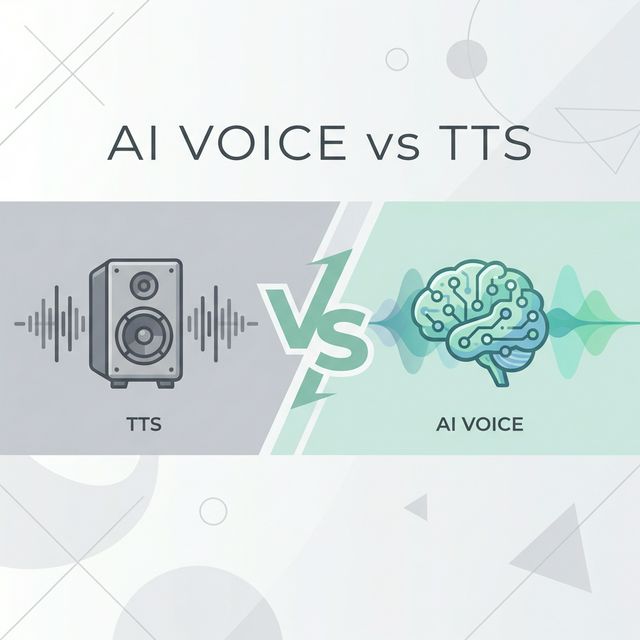
If you've used modern text-to-speech (TTS) technologies recently, you've likely noticed a dramatic improvement in how natural they sound compared to just a few years ago. Gone are the robotic, monotone voices of the past—today's neural TTS voices can be remarkably human-like, complete with natural intonation, emotional inflection, and realistic pacing. But what exactly makes these AI voice generators sound so natural? Let's dive into the fascinating technology behind neural TTS and explore what sets it apart from traditional speech synthesis.
From Robotic to Human-Like: The Evolution of TTS Technology
Traditional TTS Systems: The Building Blocks Approach
To understand why neural TTS feels revolutionary, we first need to look at how traditional TTS systems worked.
Traditional or "concatenative" TTS systems operated by:
- Recording a voice actor speaking numerous words and phrases
- Splitting these recordings into individual sound segments (phonemes, diphones, or larger units)
- Storing these segments in a database
- At synthesis time, selecting and stitching together the appropriate segments to create new utterances
While this approach produced intelligible speech, it had significant limitations:
- Unnatural Transitions: Joins between sound segments were often detectable, creating a "choppy" quality
- Limited Expressiveness: Capturing variations in tone and emotion required exponentially more recordings
- Resource Intensive: Building a high-quality voice required recording thousands of phrases
- Poor Adaptation: Adding emphasis or changing speaking style required entirely new recordings
The result was speech that, while understandable, lacked the natural rhythm and prosody of human conversation.
Enter Neural TTS: Learning Human Speech Patterns
Unlike their predecessors, neural network TTS systems don't just stitch together pre-recorded sounds. Instead, they learn the underlying patterns and characteristics of human speech through deep learning.
Here's how a typical neural TTS pipeline works:
- Acoustic Model: Neural networks analyze vast amounts of speech data to learn the relationship between text and speech acoustic features
- Prosody Prediction: Dedicated networks predict natural rhythm, stress, and intonation patterns
- Vocoder: Advanced algorithms transform acoustic features into natural-sounding waveforms
The key difference? Rather than using a fixed library of sounds, neural systems generate speech from scratch based on patterns they've learned—much closer to how humans actually speak.
The Key Technologies Behind Neural TTS Voices
Deep Learning Architecture
At the heart of neural TTS are sophisticated deep learning architectures:
- Sequence-to-Sequence Models: These models, including Transformers and LSTMs (Long Short-Term Memory networks), excel at mapping input sequences (text) to output sequences (speech parameters).
- Attention Mechanisms: These help the model focus on relevant parts of the input text when generating each part of the speech output, creating more coherent pronunciation.
- Autoregressive Generation: Many systems generate speech frame by frame, with each new frame dependent on what came before—similar to how humans speak.
Acoustic Modeling Breakthroughs
To sound natural, a voice must accurately model numerous acoustic properties:
- Spectral Features: Neural models capture the rich spectral details that give a voice its characteristic timbre.
- Duration Modeling: Advanced models predict how long each sound should last in different contexts.
- F0 Contours: Neural networks accurately model the fundamental frequency patterns that determine the rise and fall of pitch in speech.
Vocoders: Turning Parameters Into Sound Waves
The final piece of the puzzle is the neural vocoder, which converts acoustic parameters into actual sound waves:
- WaveNet: One of the first neural vocoders, developed by DeepMind, which generates raw audio waveforms one sample at a time.
- WaveRNN/WaveGlow: More efficient neural vocoders that make real-time generation possible.
- HiFi-GAN: A newer approach that uses generative adversarial networks to create high-fidelity audio with less computation.
What Makes Neural TTS Sound Human: The Details Matter
Natural Prosody
Prosody refers to the patterns of rhythm, stress, and intonation in speech—and it's essential for natural-sounding TTS:
- Contextual Awareness: Neural systems consider the entire sentence context to determine appropriate prosody.
- Phrase Boundaries: Modern systems naturally pause at commas and phrase boundaries without sounding mechanical.
- Question Intonation: Neural TTS correctly raises pitch at the end of questions and applies appropriate emphasis.
Emotional Range and Speaking Styles
Today's advanced AI speech generators can produce a variety of emotional states and speaking styles:
- Style Embeddings: Some neural TTS systems can learn different speaking styles (casual, formal, excited) from the same voice.
- Emotional Control: Advanced systems allow controlling parameters like cheerfulness, empathy, or sadness.
- Character Voices: Neural TTS can even create stylized character voices while maintaining natural speech qualities.
Handling Linguistic Complexity
Natural speech requires navigating complex linguistic rules:
- Text Normalization: Neural systems intelligently convert numbers, dates, and abbreviations into appropriate spoken forms.
- Homograph Resolution: Modern TTS can determine whether "read" should be pronounced as "reed" or "red" based on context.
- Multilingual Capabilities: Advanced systems can handle multiple languages, even switching between them mid-sentence while maintaining appropriate pronunciation.
Real-World Applications of Neural TTS
The natural quality of neural TTS has opened up applications that weren't feasible with previous technology:
Content Creation and Media
- Audiobook Narration: Publishers can create more affordable audiobooks with voices that hold listeners' attention.
- Video Voiceovers: Content creators can use online text-to-speech for professional-sounding narration without hiring voice talent.
- Podcast Production: Some podcast producers use neural TTS to create segments or even entire episodes.
Accessibility
- Screen Readers: People with visual impairments benefit from more natural-sounding screen readers that reduce listening fatigue.
- Reading Assistance: Students with dyslexia or reading difficulties can use more engaging TTS voices to access written content.
- Communication Aids: People who've lost their ability to speak can use personalized neural voices that better represent their identity.
Business and Customer Service
- Interactive Voice Response (IVR): Customer service systems sound more welcoming and less frustrating with neural voices.
- Virtual Assistants: Digital assistants benefit from natural-sounding responses that create a more engaging user experience.
- Training Content: Companies can quickly create training materials with professional voiceovers.
The Future of Neural TTS: What's Next?
Neural TTS technology continues to advance rapidly. Here's what we can expect in the coming years:
Even More Natural Speech
- Conversational Dynamics: Future systems will better handle the back-and-forth rhythms of conversation, including appropriate pauses, fillers, and reactions.
- Contextual Understanding: Deeper integration with NLP (Natural Language Processing) will improve appropriate emphasis on key words and phrases.
- Emotional Intelligence: TTS systems will better match emotional delivery to content, even for complex emotions like sarcasm or wistfulness.
Personalization and Voice Cloning
- Low-Resource Voice Adaptation: Creating a custom voice will require even less recorded speech, perhaps just minutes instead of hours.
- Voice Preservation: People facing voice loss from diseases like ALS can preserve their voice with minimal samples.
- Improved Ethical Frameworks: The industry will develop stronger consent and verification systems to prevent misuse of voice cloning technology.
Multimodal Integration
- Visual-Speech Alignment: TTS will better synchronize with visual elements like avatars and animations.
- Cross-modal Emotion: Systems will coordinate speech with facial expressions and gestures for holistic communication.
- Ambient Context Awareness: Voice responses might adapt to the user's environment or situation.
Using Neural TTS on tts-free.online
Our free text-to-speech service leverages the power of neural TTS technology to provide natural-sounding voices without the cost typically associated with premium voice services.
How Our Neural Voices Work
Our platform uses state-of-the-art neural network approaches, offering:
- High-quality voice synthesis that captures natural intonation and rhythm
- Multiple language support with native-sounding pronunciation
- Adjustable speaking styles to match your content needs
- Fast generation thanks to optimized neural architectures
Tips for Getting the Most Natural Results
To achieve the most human-like output from our free TTS converter:
- Add punctuation: Commas, periods, and question marks help the system determine appropriate pauses and intonation.
- Consider context: Provide complete sentences rather than isolated phrases for better prosody.
- Use phonetic spelling: For uncommon words or names, try phonetic spelling if pronunciation isn't coming out right.
- Experiment with voices: Different neural voices may handle certain types of content better than others.
Conclusion: The New Era of Digital Speech
Neural TTS represents a fundamental shift in how computers generate speech. Instead of mechanically assembling pre-recorded sounds, these systems have learned to speak more like humans do—with all the subtle variations, rhythms, and expressions that make human speech engaging.
As the technology continues to improve, the line between synthetic and human speech will continue to blur. For users, this means more natural interfaces, greater accessibility, and new creative possibilities.
Ready to experience the natural sound of neural TTS for yourself? Try our free online text-to-speech tool and hear the difference that neural technology makes!