If you have ever searched for tools to turn your script into audio, you have likely run into two different terms: Text-to-Speech (TTS) and AI Voice Generator.
Are they the same thing? Or is one better than the other?
The short answer: They used to be different, but they are merging. In 2026, the line is blurry. But understanding the nuance can help you pick the right tool for your video, podcast, or app.
The Old School: What is Traditional "Text-to-Speech"?
Historically, Text-to-Speech (TTS) referred to assistive technology designed to read screens for visually impaired users. The technology dates back to the 1960s when researchers first attempted to synthesize human speech using computers.
- How it sounded: Robotic, flat, and often mispronounced words. Think of the iconic voice of Stephen Hawking's speech synthesizer.
- How it worked: It pieced together pre-recorded sounds (phonemes) without understanding the context or emotion of the sentence. This approach is called concatenative synthesis.
- Best for: GPS navigation, screen readers, simple notifications, and accessibility tools.
Traditional TTS systems relied on rule-based approaches. Engineers would manually program pronunciation rules, and the system would string together sound fragments. While functional, these voices lacked warmth, natural rhythm, and emotional range.
The New Wave: What is an "AI Voice Generator"?
AI Voice Generators are the evolution of TTS. They use Deep Learning and Neural Networks to "understand" the text before speaking it. Instead of following rigid rules, these systems learn from millions of hours of human speech recordings.
- How it sounds: Often indistinguishable from humans. It includes breath, pauses, intonation, and even emotion (happy, sad, excited).
- How it works: The AI predicts the audio waveform based on vast datasets of human speech. Models like Tacotron, WaveNet, and VITS have revolutionized the field.
- Best for: YouTube videos, audiobooks, marketing content, e-learning courses, and professional voiceovers.
The key breakthrough came with neural network architectures that could model the complex patterns of human speech. These models don't just convert letters to sounds—they understand context, emphasis, and even the emotional undertone of a sentence.
The Technical Differences Explained
Understanding what happens under the hood helps explain why AI voices sound so much better.
Concatenative Synthesis (Traditional TTS)
Traditional systems work like a puzzle. They store thousands of tiny audio clips (diphones or triphones) and stitch them together based on the input text. The result often sounds choppy because:
- Transitions between sounds are unnatural
- No understanding of sentence context
- Fixed prosody (rhythm and intonation)
Neural Text-to-Speech (AI Voice Generators)
Modern AI systems take a fundamentally different approach:
- Text Analysis: The model first analyzes the entire sentence, understanding grammar, punctuation, and meaning.
- Acoustic Modeling: It predicts acoustic features like pitch, duration, and energy for each phoneme.
- Waveform Generation: A vocoder (like HiFi-GAN or WaveGlow) converts these features into actual audio waves.
This end-to-end learning approach means the model discovers patterns humans never explicitly programmed.
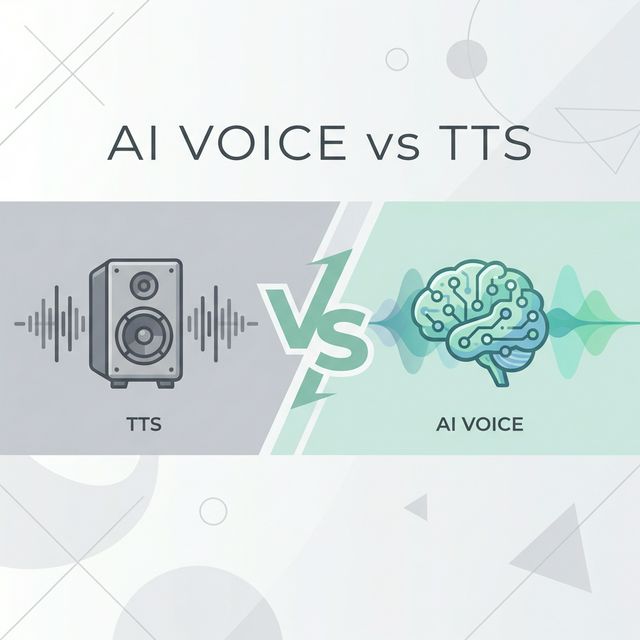
Comparison: TTS vs. AI Voice
| Feature | Traditional TTS | AI Voice Generator |
|---|---|---|
| Technology | Concatenative Synthesis | Neural Networks / Deep Learning |
| Emotion | None (Flat) | High (Can express anger, joy, etc.) |
| Cost | Very Low / Free (OS built-in) | Often Paid (Compute intensive) |
| Customization | Speed, Pitch | Style, Emotion, Cloning |
| Realism | 🤖 Robotic | 🗣️ Human-like |
| Processing | Instant | May require more compute |
| Voice Cloning | Not possible | Supported by many platforms |
Which One Do You Need?
Choose Traditional TTS if:
- You are building a basic accessibility tool where clarity matters more than naturalness.
- You need to run it offline on low-end hardware with limited processing power.
- The "robotic" aesthetic is what you are going for (e.g., retro sci-fi, artistic projects).
- You need extremely fast, real-time synthesis with minimal latency.
- Budget is extremely tight and you cannot afford any API costs.
Choose an AI Voice Generator if:
- Engagement matters. You are making content for TikTok, YouTube, or Instagram where viewer retention depends on audio quality.
- You need character. You want a narrator that sounds authoritative, friendly, dramatic, or matches a specific brand voice.
- You want to save money. Hiring a human voice actor costs \$100s per project; AI costs pennies (or nothing).
- You need multiple languages. AI voices often support dozens of languages with native-like pronunciation.
- You want voice cloning. Some platforms let you create a custom voice from just a few minutes of sample audio.
Common Use Cases in 2026
Content Creation
YouTubers and podcasters use AI voices for narration, especially for explainer videos, documentaries, and educational content. The quality is now good enough that many viewers cannot tell the difference.
E-Learning
Course creators leverage AI voices to produce hours of training content without booking studio time. Updates and corrections can be made instantly by regenerating the audio.
Accessibility
While traditional TTS still powers screen readers, AI voices are making audiobooks and article narration more enjoyable for visually impaired users.
Gaming and Interactive Media
Game developers use AI voice generators to create dialogue for NPCs (non-player characters), enabling dynamic conversations that would be too expensive to record with human actors.
Customer Service
IVR systems and virtual assistants now use neural voices to provide a more pleasant caller experience, reducing frustration and improving customer satisfaction.
The Good News: You Don't Have to Choose
In 2026, the best tools have combined these worlds.
Our tool, tts-free.online, is technically a Text-to-Speech converter because it takes text and speaks it. But under the hood, it uses advanced AI Voice Generation models to ensure the output is natural and lifelike.
You get the ease of use of a simple TTS tool with the quality of a high-end AI generator. No complex settings to configure, no API keys to manage, and no subscription fees to worry about.
The Future: Where Are We Headed?
The distinction between TTS and AI voice generators will continue to blur. We are seeing:
- Real-time emotional adaptation: Voices that adjust tone based on content sentiment
- Personalized voices: Custom voices trained on just seconds of audio
- Multimodal integration: Voice generation that considers visual context
- Zero-shot voice cloning: Creating any voice without prior training
Conclusion
Don't get hung up on the terminology. Whether you call it "TTS" or "AI Voice," what matters is the result.
- Does it sound human?
- Is it easy to use?
- Is it free?
If the answer is yes, you have found the right tool.
Ready to hear the difference? Try our free AI Voice Generator now and turn your text into lifelike speech in seconds.