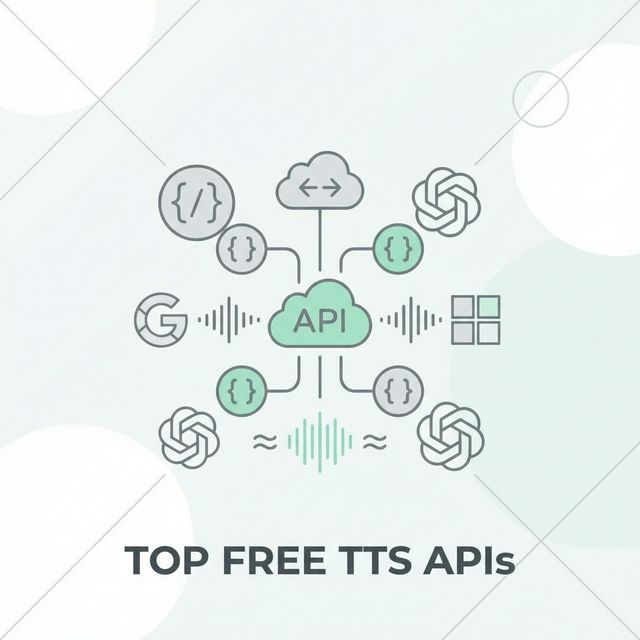
For developers building apps, accessibility tools, or content automation pipelines, finding the right Text-to-Speech (TTS) API is a balancing act. You need natural-sounding voices, low latency, and ease of use—but you also need to manage costs.
While giants like Google and Amazon offer powerful solutions, their "free tiers" often come with strict limits and credit card requirements. In this guide, we break down the top 5 free (and freemium) TTS APIs in 2026 to help you choose the right stack for your project.
1. Google Cloud Text-to-Speech
The Industry Standard
Google's Wavenet voices set the bar for neural TTS. Their API is robust, reliable, and supports a massive range of languages.
- Pros: Incredible voice quality (Neural2), deep SSML support, integrates well with other Google Cloud services.
- Cons: Setup is complex (requires GCP console, service account keys).
- Free Tier: 4 million characters/month for standard voices, but only 1 million for WaveNet (premium) voices. Requires a credit card to activate.
2. Microsoft Azure AI Speech
Best for Expressive Voices
Azure is widely regarded for having some of the most human-like prosody on the market, especially with their "speaking style" features (e.g., whispering, shouting, newscasting).
- Pros: Granular control over intonation and emotion; very natural output.
- Cons: Like Google, the setup overhead is high for simple projects.
- Free Tier: 0.5 million characters per month for neural voices.
3. Amazon Polly (AWS)
The Reliable Workhorse
AWS Polly is a staple in the industry. While its standard voices can sound a bit dated compared to Azure's latest models, its neural engine is solid.
- Pros: High stability, huge ecosystem, "Brand Voice" capability.
- Cons: The Free Tier expires after 12 months for new AWS customers.
- Free Tier: 5 million characters/month for the first year (standard voices).
4. Coqui TTS (Open Source / Self-Hosted)
For Total Control
If you want zero dependency on cloud providers and have the GPU resources, open-source libraries like Coqui (forked from Mozilla TTS) are powerful.
- Pros: No API costs, total privacy, runs offline or on your own server.
- Cons: Requires significant hardware (GPU) for low latency; maintenance is on you. Voice quality varies by model.
- Free Tier: Truly free, but you pay for your own infrastructure.
5. tts-free.online
The "No-Hassle" Web Solution
Sometimes you don't need a complex cloud infrastructure—you just need to generate audio assets quickly for your web app, game, or content pipeline.
- Pros: No credit card required, instant access, high-quality neural voices, completely free for unlimited generation via the web interface.
- Cons: Currently optimized for web generation and download rather than real-time streaming API integration.
- Best For: Developers who need to batch-generate audio files for assets, e-learning modules, or static content without managing API keys or billing.
Comparison Table
| API Provider | Neural Quality | Free Limit | Setup Difficulty | Best Use Case |
|---|---|---|---|---|
| Google Cloud | ⭐⭐⭐⭐⭐ | 1M chars/mo | High | Enterprise Apps |
| Azure Speech | ⭐⭐⭐⭐⭐ | 0.5M chars/mo | High | Emotional Narratives |
| AWS Polly | ⭐⭐⭐⭐ | 5M chars/mo (12 mo) | High | Scalable SaaS |
| Coqui (Self-Hosted) | ⭐⭐⭐ | Unlimited | Very High | Offline/Privacy |
| tts-free.online | ⭐⭐⭐⭐ | Unlimited (Web) | Zero | Content Assets |
Conclusion: Which One Should You Choose?
- Building a commercial SaaS? Go with Google or Azure for their SLA and scalability, but be prepared to pay once you scale.
- Hobby project or internal tool? AWS Polly is a safe bet if you are in the 12-month free tier window.
- Need assets NOW? If you just need to turn text into MP3s for your app or video without writing a single line of Python, tts-free.online is your fastest path. No keys, no config, just audio.
Ready to test the quality? Try our Free TTS Generator now and hear the difference neural voices make.